Posts

The benefits of learning to disobey

Image
  In researching intelligent disobedience, the greatest parallels are drawn to guide dogs. Chaleff, in readings and lectures, discusses how a guide dog must not only refuse to act unsafely on behalf of their owner, but go as far as counterpull them in a better direction. While obedience is a very important piece for working dogs, their utilization of intelligent disobedience can save lives. In recent years, specifically pertaining to culture in America, it is my opinion that people are becoming more and more active in their followership roles. Individuals are questioning leaders at work, society and politics more and more. This can be beneficial as a catalyst for change. For instance, there has been a shift in expectations for work-life balance and holding institutions accountable against their mission statements and improvements to the environment in the workplace. Questioning traditional methods and mitigating expectations, when done through intelligent disobedience, can create ...

Followers leading towards a better leader/follower dynamic

Image
  What? The leader/follower relationship is one that we see in many different facets of our lives: parenting, sports, work, friend groups, etc. The dynamic can look different, but often times, there can be a bias that the leader’s role is more valuable. However, more and more research is starting to focus on the value of the follower and while both roles are equally important, there is a one significant piece that sets them apart: you can have followers without a leader, but you can’t have a leader without followers. The relationship can only be made stronger by a deeper understanding of how the balance between the two is beneficial for all. Most research is focused on followers as it effects leaders . Learning why this is important could help shift the external view of the dynamic to better mirror the real-life relationship. So what? Though some leadership/followership roles are forged on our behalf, that does not negate that fact that we can all be innately both, often simu...

Gen Z’s place in the leader/follower relationship

Image
  What? Prior to and in the aftermath of the pandemic, members of Gen Z have joined the workforce. Coming into a hybrid or modified role, it has been suggested that members of this generation have increased difficulty adapting to the expectations of their roles in many facets. In my own work experience, I have seen the differences between generations and how they approach different job responsibilities.   One specific facet of being apart of a working team, that may be a pose a learning curve, is adjusting to leader/follower dynamic.   This is a challenge both by gen z and others in the workplace to adjust the working environment. This is not to say that all of the needs of Gen z are ones that should be met, but there are adjustments on both sides that can be made to better the workforce as a whole. This is similar to how, in general, both leaders and followers need to make cohesive adaptations to allow their relationship to be the upmost beneficial. So, what? When ...

Evaluating the Evaluations of Extension; why it matters?

Image
  What?               Extension education is an entity, funded by land-grant universities nationwide, that’s purpose is to bridge opportunities of lifelong learning to local community members. These programs have deep historical roots in agriculture and home economics, but in recent years have expanded to programming areas such as STEAM (Science, Technology, Engineering, Arts, and Math), civic engagement, and healthy living. Depending on the area, the extension agent, and the specific program being held, the target audience may vary between different ages. For instance, many agriculture extension agents will, oftentimes, have a lot of programming geared to farmers and other adults in the community. In opposition, 4-H agents may have a canning class held for children ages 9-19 or an embryology project for a kindergarten class. Non-formal education is an essential piece of extension programming and with that, a lot o...

Technology in education: What it has been through and what now?

Image
  What?               The digital age has made very steady advances since the creation of the internet in the 1960’s and even more so since the invention of the World Wide Web in 1989. That being said, though technology has been steadily progressing through the decades, digital advancements have been in overdrive since the pandemic began in 2020. With face-to-face communication being limited in almost every facet of life, like shopping, healthcare, education, and even personal relationship, people needed to adapt; More than consumers, companies needed to adapt to stay socially and economically relevant and some even found more lucrative ways of doing business. Because the world was given no warning of this, digital advances made may not have been made so soon, or even at all . This is truer for technological advances surrounding learning. So, What?           ...

Why should we facilitate a conversation on facilitation?

Image
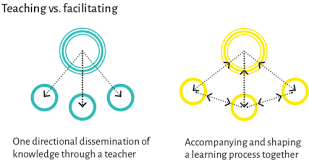
  What? A vital difference in K-12 learning and much of adult learning, specifically non-formal adult learning, is the voluntary role they play as students. Adult learners may be required to take courses or attend seminars for maybe a job or volunteer role, but they play a larger part in decision making where their lifelong learning journey leads. It is because of this overarching ideal that they tend to need to feel more involved in their learning. In a sense, it is simpler to tell a small child that their teacher has this knowledge and experience to bestow upon them, whereas an adult will have their own experiences to draw from and possibly different points of view to connect their new knowledge too. Evolving from a “traditional” teacher dynamic to a facilitator dynamic can work to foster this relationship. So, what? While teachers can be facilitators, the teaching and facilitation have many differences from one another. For starters, in teaching, the learning is controlled...

Lifelong Learning: a self-directed and transformational opportunity

What? As I embark on the final portion of my formal education journey, I am trying to find ways to transition, as many others have, from my stage of long-term, yet ephemeral formal education to the continuous stage of lifelong learning. While informal learning can take place without even having the intention to learn, lifelong learning can take more conscious effort than I once anticipated. As the world races through and towards technological advancement, it is vital that we not only improve access to resources for those partaking in lifelong learning opportunities, but also show the value in doing so.  So What In pedagogy, learning is typically either, more-so, teacher-centered or learner-centered; The former approaches learning with the view that teachers have the knowledge and wisdom, and students are to receive the aforementioned knowledge from them, whilst the latter is more working in tandem with the teacher as more of the "facilitator" . Learner-centered approaches are...